
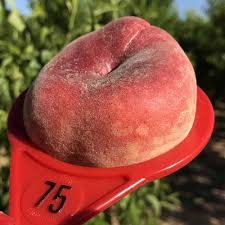
Flat Peach Varieties: Ripening Calendar and Growing Tips
Updated on 10/28/2026
The flat peach has a squashed, doughnut-shaped fruit with sweet flesh and low acidity. It is also sold as saturn, paraguayo, UFO or doughnut peach. Botanically it is the same species as the common peach, Prunus persica, variety platycarpa.
Growers are interested for two reasons. Buyers look for it as a distinctive fruit, and newer varieties have fixed most of the defects of the old types. Below is what to know and a ripening calendar for the 20 flat peach varieties in the Raludor catalogue.
Where the flat peach comes from
The flat shape has been described in China for almost a thousand years under the name "pan tao". In Europe, flat peaches reached Sicily around 1950. The old types had problems: the fruit cracked, opened at the apex, and the short stalk tore the skin at harvest.
Systematic breeding began in the late 1980s, first in France from the American variety Stark Saturn, then in Italy with the UFO series. UFO varieties have fruit 6–8 cm across and between 11 and 17 °Brix. UFO 4 became the reference variety against which other flat peaches are timed.
What modern varieties bring
- Less cracking. Osiris, Piattaforone, Pink Ring, Contessa and Plane Silver are described as crack-resistant.
- Large fruit. Zodiac, Babylone, Filoe and Pink Ring reach 70–80 mm.
- Colour. Many new varieties have 60–90% deep red skin, which helps sales.
- White or yellow flesh. Most have white flesh. Piattaforone, Platerina 110, Plane Gold, Plane Top and Platerina 264 have yellow flesh.
- Storage. Pink Ring, Platerina 110 and Plane Gold keep very well in cold storage.
Ripening calendar for 20 varieties
All 20 varieties in the catalogue are self-fertile. Planted in sequence, they cover about three months, from late June to late September.
| Variety | vs UFO 4 | Ripening (guide) | Flesh | Brix | Note |
|---|---|---|---|---|---|
| Zodiac | −17 days | late June | white | 13.7 | 70–80 mm |
| Kiwani | −13 days | late June | white | 13 | — |
| Sauzee 667 | −10 days | early July | white | 13 | late bloom |
| Divadona | −6 days | early July | white | 13 | — |
| Samantha | +2 days | mid July | white | 16 | very sweet |
| Osiris | +5 days | mid July | white | 16 | crack-resistant |
| Piattaforone® | +11 days | late July | yellow | 14–16 | crunchy |
| Contessa | +17 days | late July | white | 14 | ~80 mm, no cracking |
| Babylone | +28 days | early August | white | 14 | 70–80 mm |
| Pink Ring® Piattafortwo | +45 days | late August | white | 18 | ~130 g, long storage |
| Concettina® | +48 days | late August | white | 14–16 | sweet-sour |
| Platerina 110 | +50 days | late August | yellow | 13 | late bloom, stores well |
| Sauzee 665 | +55 days | early September | white | 12 | late bloom |
| Pasionata | +58 days | early September | white | 16 | low acid, aromatic |
| Sauzee 660 | +67 days | mid September | white | 13 | 90% red |
| Filoe | +71 days | mid September | white | 14 | 70–80 mm, late bloom |
| Plane Silver | +73 days | late September | white | 14 | crack-resistant |
| Plane Gold | +75 days | late September | yellow | 14 | stores very well |
| Plane Top | +76 days | late September | yellow | 13 | — |
| Platerina 264 | +77 days | late September | yellow | 14 | crunchy |
Ripening is given in days relative to UFO 4, which ripens in mid July in the Raludor calendar. Months are a guide and shift with site and year.
How to choose varieties
For continuous local sales, pick 4–5 varieties spaced 2–3 weeks apart. For example: Zodiac in late June, Osiris in mid July, Babylone in early August, Pink Ring in late August and Plane Gold in September.
For storage and distant markets, firmness and storage life matter. Pink Ring, Platerina 110 and Plane Gold are the best fits in the catalogue.
For sites with late frost, look for late bloom. Platerina 110 blooms late and handles spring frost well, and Sauzee 667, Sauzee 665 and Filoe also bloom late.
Growing tips
Flat peaches need the same conditions as common peaches: sun, well-drained soil and a site away from cold air pockets. They bloom early, so frost-prone hollows are a risky choice.
They fruit mainly on one-year-old shoots, so they need fruiting pruning every year. Fruit thinning decides size, and large flat peaches sell better.
Harvest needs care. The flat fruit has a short stalk and the skin tears easily if the fruit is pulled. Twist it off and lay it in a single layer in shallow crates. For August and September varieties, irrigation and anti-hail netting protect a crop that hangs on the tree for a long time.
Browse all flat peach varieties, peach varieties or ask for a variety plan through the contact page.
Frequently asked questions
What is a flat peach?
It is a peach with a flattened fruit, Prunus persica var. platycarpa, also called saturn, paraguayo, UFO or doughnut peach. It usually has sweet flesh and low acidity.
Are flat peaches self-fertile?
Yes. All 20 flat peach varieties in the Raludor catalogue are self-fertile and can be planted without a pollinator.
When do flat peaches ripen?
It depends on the variety. Zodiac ripens in late June, UFO 4 in mid July, and Plane Gold, Plane Top and Platerina 264 in late September.
Can flat peaches be grown in Moldova?
Yes, under the same conditions as common peaches. Choose a sunny site without cold air pockets, and later-blooming varieties if your springs are cold.
White or yellow flesh?
White-fleshed varieties are usually sweeter and less acidic. Yellow-fleshed ones, such as Plane Gold or Platerina 110, are firmer and store better.
Sources: FreshPlaza, history of flat peaches, Cirilli et al., Tree Genetics & Genomes, 2021 and the Raludor variety sheets.