
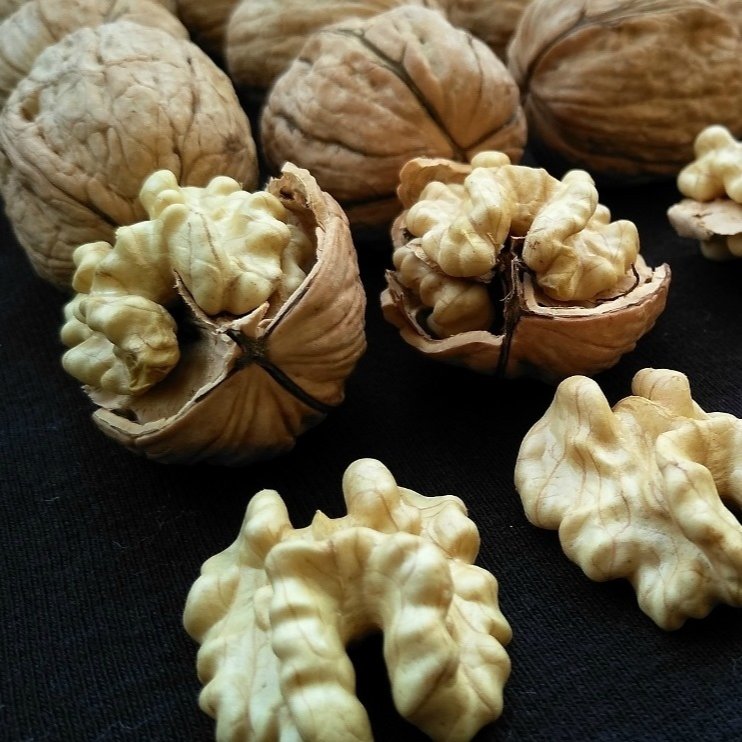
Walnut Varieties: Chandler, Serr, Lara, Fernor and Pescianski
Updated on 10/28/2026
Walnuts are one of Moldova's traditional crops, and the country remains a significant walnut exporter. New orchards are increasingly planted with grafted trees rather than seedlings. A grafted variety gives uniform trees, comes into bearing sooner and produces nuts of the same size and kernel colour, which matters when you sell.
A walnut variety is chosen on three criteria: bearing habit, pollination and the market you sell to, in-shell nuts or kernels. Below we go through each and compare the 12 walnut varieties in the Raludor catalogue.
Lateral or terminal bearing
In terminal-bearing varieties, nuts form only at the tips of shoots. The trees are large, come into bearing later and yield less per tree. Franquette, Rubin and Carpatica belong to this group.
In lateral-bearing varieties, lateral buds also bear fruit. Chandler has 85–90% fruitful lateral buds, Fernor about 90%, Vina about 80%, Tulare over 75% and Serr about 50%. These varieties come into bearing sooner and yield more, but they need matching water and nutrition.
Pollination and dichogamy
Walnut trees carry separate male flowers (catkins) and female flowers that do not mature at the same time. This is called dichogamy.
- Protandrous varieties shed pollen before their female flowers are receptive: Chandler, Serr, Vina, Tulare.
- Protogynous varieties have female flowers ready before their pollen: Franquette, Pescianski, Ferjean.
A good pollinator sheds pollen exactly when the main variety's female flowers are receptive. That is why Chandler is planted with Franquette, a late-blooming protogynous variety. Walnuts are wind-pollinated, so pollinator trees should be spread through the orchard rather than grouped in one corner.
Leafing out and frost
Late-leafing varieties escape spring frost and bacterial blight more often. Chandler, Fernor, Rubin and especially Franquette leaf out late. Serr leafs out early and is more susceptible to blight and codling moth.
Table of 12 walnut varieties
| Variety | Origin | Bearing | Harvest | Pollination | Kernel and notes |
|---|---|---|---|---|---|
| Chandler | USA, UC Davis, 1979 | lateral, 85–90% | late Sept, early Oct | Franquette, Cisco, Fernette | over 90% extra-light kernel; late leafing |
| Serr | USA, UC Davis, 1968 | lateral, ~50% | early to mid Sept | protandrous, early pollen | 96% light kernel, 59% yield; blight-susceptible |
| Tulare | USA, UC, 1966 | lateral, over 75% | mid Sept | self-fertile; Franquette, Lara, Fernor | ~85% light kernel, ~53% yield |
| Vina | USA, UC Davis, 1968 | lateral, ~80% | second half of Sept | Chico, Chandler, Howard, Tehama | high, consistent yields |
| Lara | France, 1980s | lateral | late Sept, early Oct | partly self-fertile; Franquette, Fernor, Fernette | bears in 3–5 years; tolerates late frost |
| Fernor | France, INRA, 1995 | lateral, ~90% | early Oct | partly self-fertile; Fernette, Franquette | late leafing; blight-resistant |
| Ferjean | France, INRA, 1999 | lateral | — | protogynous, good pollinator | for the kernel market; blight-resistant |
| Franquette | France, traditional | terminal | October | protogynous, pollinator for Chandler | very late leafing; thin shell |
| Pescianski | Moldova, local variety | lateral | last third of Sept | partly self-fertile; Costiujeni, Călărași, Schinoasa | white kernel, 55–60% yield; drought- and frost-hardy |
| Rubin | Moldova / Romania, 2022 | terminal | October | — | red-purple kernel; late leafing |
| Ovata | Moldova | — | — | — | ~24 g nut, for in-shell sales |
| Carpatica | Moldova | terminal | September | — | giant nut, up to 50 g |
Data comes from the Raludor variety sheets. Harvest periods are a guide.
Which variety for which market
For the kernel market, light colour and kernel yield matter. Chandler has over 90% extra-light kernel, Serr 96% light kernel with a 59% yield, and Tulare about 85% light kernel.
For in-shell sales, size and appearance matter. Ovata, at about 24 g per nut, and Carpatica, with nuts up to 50 g, are aimed at this market.
For reliability in local conditions, Pescianski is the most valued native Moldovan variety. It is drought- and frost-hardy with a 55–60% kernel yield.
Pollination pairings
- Chandler with Franquette, Fernette or Cisco.
- Lara with Franquette, Fernor or Fernette.
- Fernor with Fernette or Franquette.
- Vina with Chandler, Chico, Howard or Tehama.
- Pescianski with Costiujeni, Călărași or Schinoasa.
Browse all walnut varieties in the catalogue, read how to choose the right varieties or ask for a planting plan with pollinators through the contact page.
Frequently asked questions
What is the best walnut variety for Moldova?
No single variety suits every orchard. Chandler is the standard for quality kernels, Pescianski for adaptation to local conditions, and Lara and Fernor for sites at risk of late frost.
Which pollinator does Chandler walnut need?
Chandler is protandrous. Recommended pollinators are Franquette, Fernette and Cisco, which shed pollen when Chandler's female flowers are receptive.
How soon does a grafted walnut start bearing?
Lateral-bearing varieties start sooner. The Raludor sheet gives 3–5 years for Lara. Terminal-bearing varieties such as Franquette bear later.
What does lateral bearing mean in walnuts?
It means lateral buds bear nuts too, not only those at shoot tips. The tree has more fruiting points and yields more at the same size.
Serr or Chandler?
Serr ripens earlier and has a high kernel yield, but leafs out early and is more prone to blight. Chandler leafs out late, has more fruitful lateral buds and a very light kernel.
Sources: UC Davis, characteristics of walnut cultivars, IPN, Moldova's walnut production and the Raludor variety sheets.